
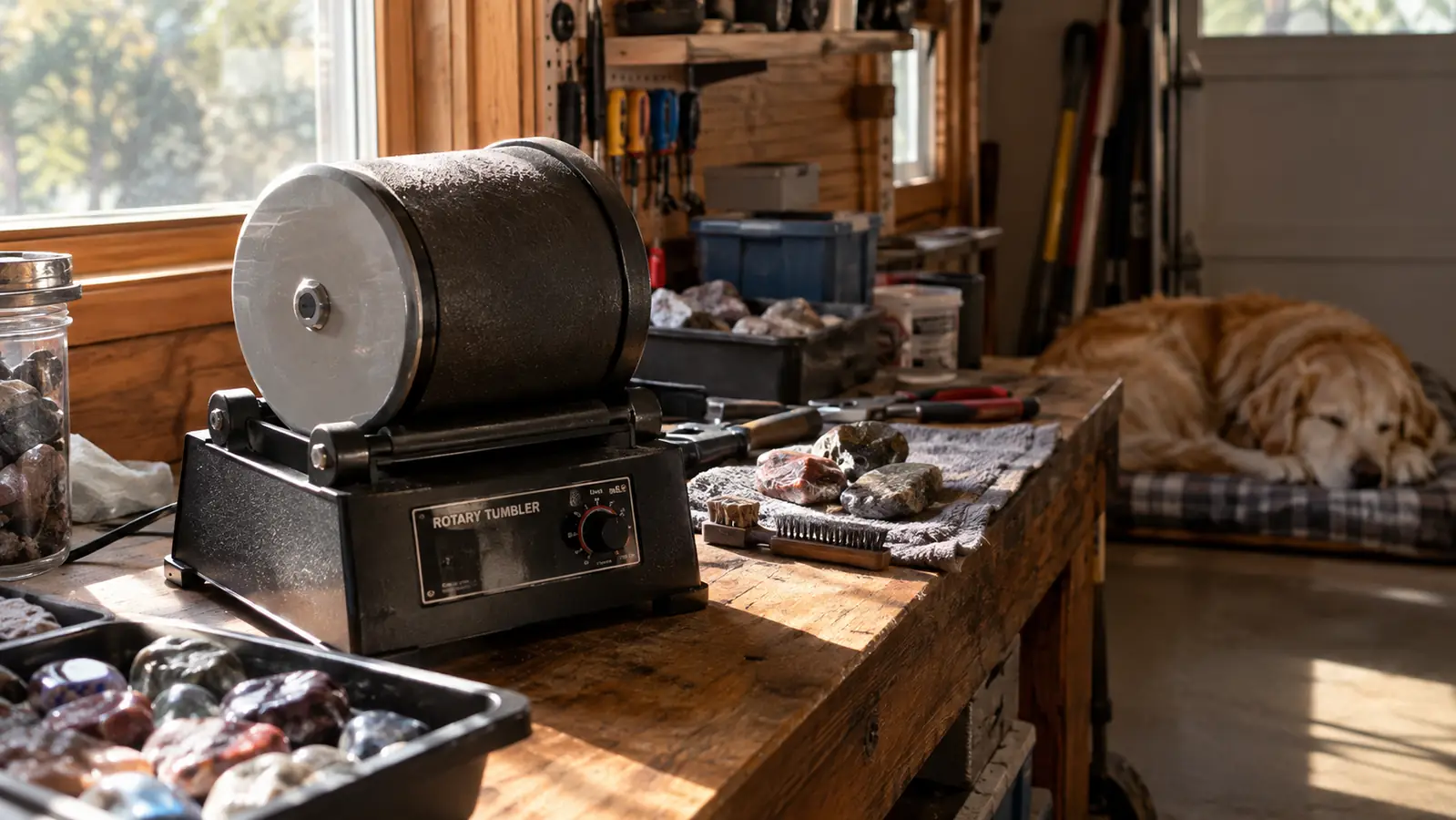
Between the Dan&Darci Advanced Professional and the National Geographic tumbler, I would buy the Dan&Darci for myself and hand the National Geographic to a grandkid. That sounds flippant, so let me unpack it. I am Gary Lindahl, a retired machinist in Tucson, and I have run rotary tumblers on my garage bench for about twelve years. I have burned up cheap motors, over-tumbled good agate into chalk, and learned the hard way that the barrel and the timer matter more than the name on the lid. This winter I ran both of these kits through a full four-stage cycle, using stones I picked in a desert wash and the grit that came in each box. The short answer is that both will turn rough rock into something you are proud to pass around, but they are built for different people.
The National Geographic Hobby Rock Tumbler is the kit I recommend when someone just wants to try tumbling without studying it. It is simple, it ships with everything you need, and it is hard to set up wrong. The Dan&Darci Advanced is the kit I recommend when you already know you like this hobby and want two batches running at once, a timer you can set and forget, and a machine that will still be going in five years. The rest of this comparison looks at the two on the things that actually matter: the timer, the barrels, the noise, the grit, and how forgiving each one is when you make a beginner mistake.
What You Are Actually Getting
Both of these are rotary tumblers, which means a motor turns a rubber-lined barrel full of rocks, grit, and water for days at a time. The rocks tumble against each other while the grit grinds them down in stages: coarse grit shapes them, medium and fine grit smooth them, and polishing compound puts on the shine. It is a slow hobby by design. A good batch takes three to four weeks, and there is no honest way to rush it without turning your stones to gravel. What a kit has to get right is the barrel, the motor, the timer, and the grit that ships in the box.
The Dan&Darci Advanced Professional kit and the National Geographic Hobby kit both get those basics right. I have watched both turn rough desert wash rocks into stones smooth enough to hold up to the light. The difference is in how they are set up for the long run. One is built to be simple, and one is built to be capable, and that one sentence is the whole review. Everything else is details, and the details are in the table below.
| Dan&Darci Advanced Professional | National Geographic Hobby Kit | |
|---|---|---|
| Timer | Digital 9-day timer with auto shutoff; set it once and it runs all four stages | 7-day mechanical timer with auto shutoff; one dial, set and forget |
| Barrels | Two barrels included, so a rough batch and a polish batch can run at the same time | One barrel, one batch at a time |
| Noise | Rubber-lined barrels take the edge off the rattle; still a garage machine | Rubber barrel helps too; still a garage machine |
| Grit and supplies | Four-stage grit set, polishing compound, and jewelry findings in the box | Grit for all four stages plus jewelry findings included |
| Learning curve | Digital buttons take a few minutes to learn, then run the whole cycle unattended | One dial, one barrel, nearly impossible to mis-set |
| Support | Responsive seller support through Amazon if a part arrives damaged | Long-established brand with a straightforward replacement promise |
| Best for | A hobbyist who wants two batches running and a set-and-forget timer | A family or first-time kid who wants to see rocks shine |
How I Compared Them
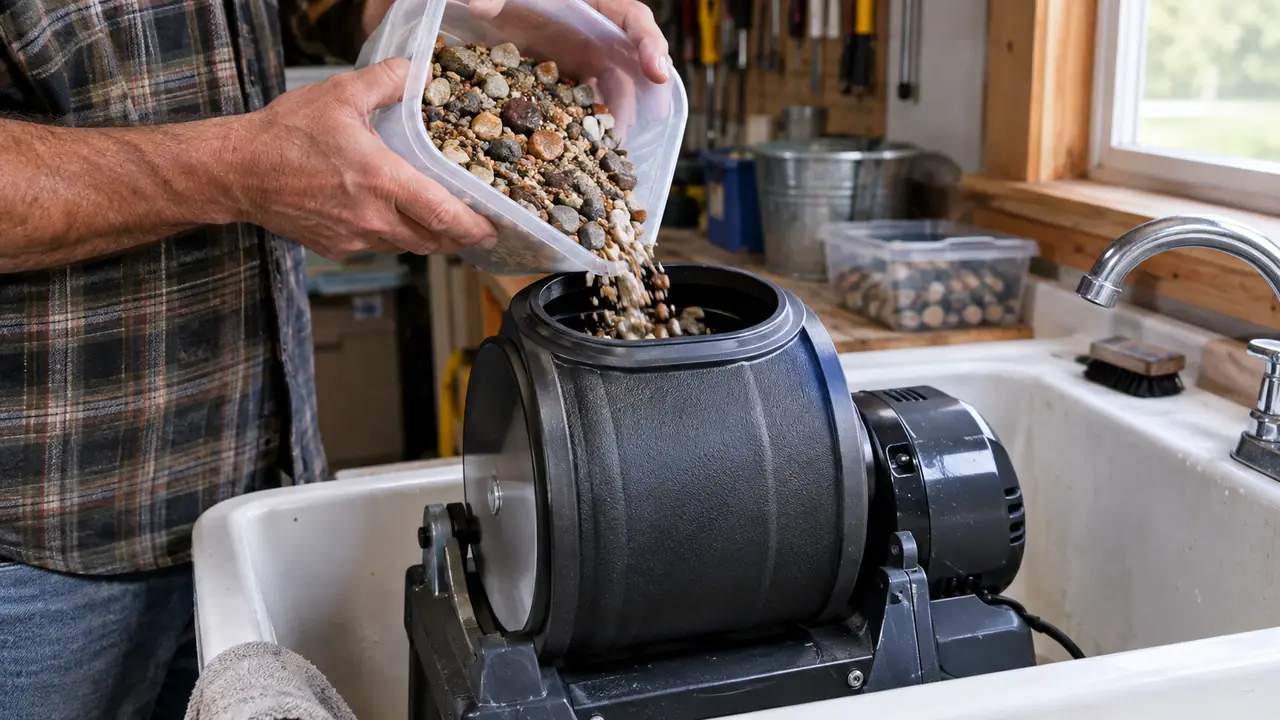
Both kits arrived with the same core parts: a motor base, a rubber-lined barrel, a lid, grit packets, and a little plastic sieve for separating stones from grit. I set them up on the same workbench, ran them on the same cycle schedule, and used the same source of water from the utility sink. I also weighed every batch before and after, because the fastest way to judge a tumbler is how much rock it actually polishes instead of grinding away.
I ran each kit through the full four-stage cycle: coarse for five days, medium for five, fine for five, and polish for four. I followed the grit amounts printed on each box, refilled the barrels with fresh water between stages, and cleaned the barrels thoroughly between grit changes, because leftover coarse grit will scratch a polish stage every time. Both machines ran without a hiccup. Neither motor overheated, neither lid leaked, and both barrels sealed well enough to leave on the bench overnight. The differences showed up in the details, which is where this comparison lives.
Where Dan&Darci Wins
The timer is the first thing you notice. The Dan&Darci lets you set a cycle up to nine days, and it shuts the machine off when the cycle is done. That matters more than it sounds. A full tumble takes three to four weeks because you run coarse, medium, fine, and polish stages, each one several days long. With a mechanical timer you are always doing arithmetic: which stage started on Tuesday, when does it end, and will I be home to switch it over. The Dan&Darci counts down on a digital display and stops on its own, so I can start a batch on a Sunday and check on it the next weekend. For a retired machinist who likes to set up a job and walk away, that is the whole ballgame.
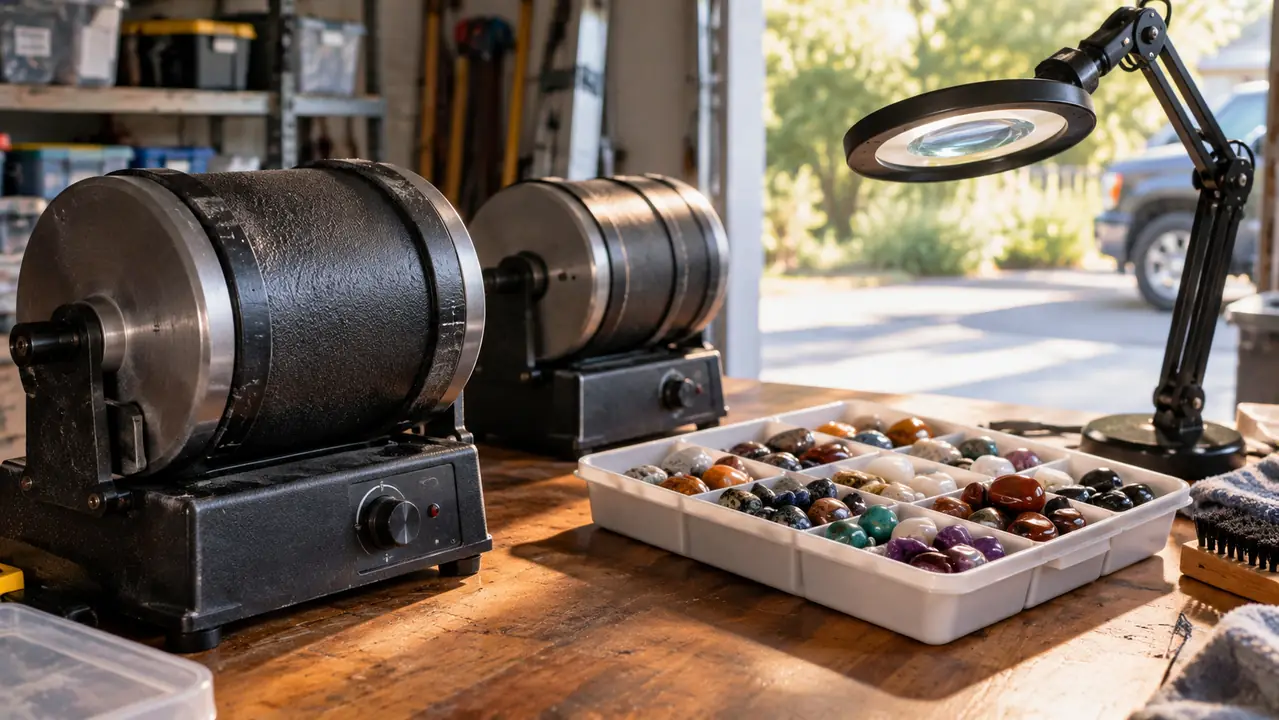
The second barrel is the other big win. Tumbling is slow, and the slow part is the bottleneck. With one barrel, you grind a batch for a week, then you have to stop, clean the barrel, and start the next stage. With two barrels, I run the rough grind in the large barrel and the polish stage in the small one at the same time, so a finished batch comes out every week instead of every month. The kit also includes the four grit stages, the polishing compound, and the little jewelry findings, so there is nothing else to buy before your first batch is done. That is the difference between a kit and a project.
Where National Geographic Wins
The National Geographic kit wins on simplicity, and simplicity is not a small thing. It has one barrel and one dial. You load the stones, add the grit, set the timer, and close the lid. There is no menu, no mode, and no manual that reads like a firmware guide. If I were buying a tumbler for a ten-year-old, I would buy this one and hand it over with a one-sentence explanation. The learning curve is basically flat, which means the kid learns the actual hobby instead of learning the machine. That is worth more than any feature list.
It also wins on support and peace of mind. National Geographic has a long track record with these kits, and their replacement promise is well known in the tumbling community. If a barrel cracks or a motor dies early, you are dealing with a company that has handled that exact problem thousands of times. The Dan&Darci kit is a very good machine, but the name on the box does not carry the same weight. For a gift, especially for someone who is not a tinkerer, that support network is worth something real. And it is the easier first purchase to make when you are not sure the hobby will stick.
If you already know tumbling is your hobby, get the two-barrel kit
The Dan&Darci Advanced Professional with the digital 9-day timer is the one I reach for on my own bench. Two barrels, four grit stages, and a timer that runs the whole cycle without me.
Amazon Check Today's Price on Amazon →Who Should Buy Which
Buy the Dan&Darci if you already know you like this hobby, or if you are the kind of person who would rather buy the right tool once than the wrong tool twice. You get two barrels, a digital timer, and a kit that is ready to run the day it arrives. It suits a hobbyist who wants a finished batch every week instead of every month, and who does not mind learning a few buttons to get there. It is also the better pick if you plan to tumble for years, because the two barrels and the digital timer give you room to grow instead of a ceiling.
Buy the National Geographic if you are buying a first tumbler for a child, or if you genuinely are not sure whether tumbling will hold your interest. The single dial, single barrel, and flat learning curve mean the first batch is almost guaranteed to come out well, and the support network makes it a safe gift. If the hobby sticks, you can graduate to a two-barrel machine later, and the National Geographic will still earn its place as a second unit for polishing small batches. There is no shame in starting simple. I started simple, and I ruined my share of batches before I learned the rhythm.
One thing worth knowing: National Geographic also sells a Pro version with two barrels and a stronger motor, and that changes the comparison. If the Pro is in your budget, it closes most of the gap on the Dan&Darci. I have not run the Pro myself, so I will not grade it here, but I have seen the two-barrel kits at the Tucson gem show and they hold up fine. The reason I still point most hobbyists to the Dan&Darci is the digital timer. The Pro gives you the extra barrel, but it keeps a simpler timer, and for me the timer is the feature that saves the most aggravation over a year of tumbling.
My Honest Take After a Month of Running Both
I ran both kits through a full four-stage cycle this winter with stones from a desert wash, following each instruction sheet exactly, and both produced nice results. The National Geographic batch came out a little smoother on the first run, mostly because its instructions are clearer about how full to fill the barrel. The Dan&Darci batch came out better on the second run, once I had the barrel fill and the grit amounts dialed in. That is the honest pattern: the simpler machine is easier to get right the first time, and the more capable machine is better once you know what you are doing.
One more note on noise, because it matters in my house. Biscuit, our nine-year-old red heeler mix, naps on a blanket in the garage and hates loud rattling. Both of these machines rattle, because that is what rotary tumblers do. The rubber barrels take the edge off, but neither one is quiet enough to run in a bedroom or next to a sleeping dog. Mine runs on the far end of the workbench, on a folded towel, and Biscuit stays on his blanket at the other end. If noise is your main concern, a rotary tumbler of any brand is the wrong tool; you would want a vibratory tumbler for that, and that is a different review.
For my part, the Dan&Darci sits on my bench today, and the National Geographic went to my neighbor's nine-year-old, who is thrilled with it. Both are good machines. They are just good for different people, and now you know which one you are. If you are still on the fence, start with the simpler kit, keep the box, and trade up if the hobby takes. That is the same advice I would give at my kitchen table, and it has never steered me wrong.
Ready to start your first batch?
The Dan&Darci Advanced Professional kit includes two barrels, the full four-stage grit set, and the digital 9-day timer. It is the one I keep running on my own bench.
Amazon Check Today's Price on Amazon →