
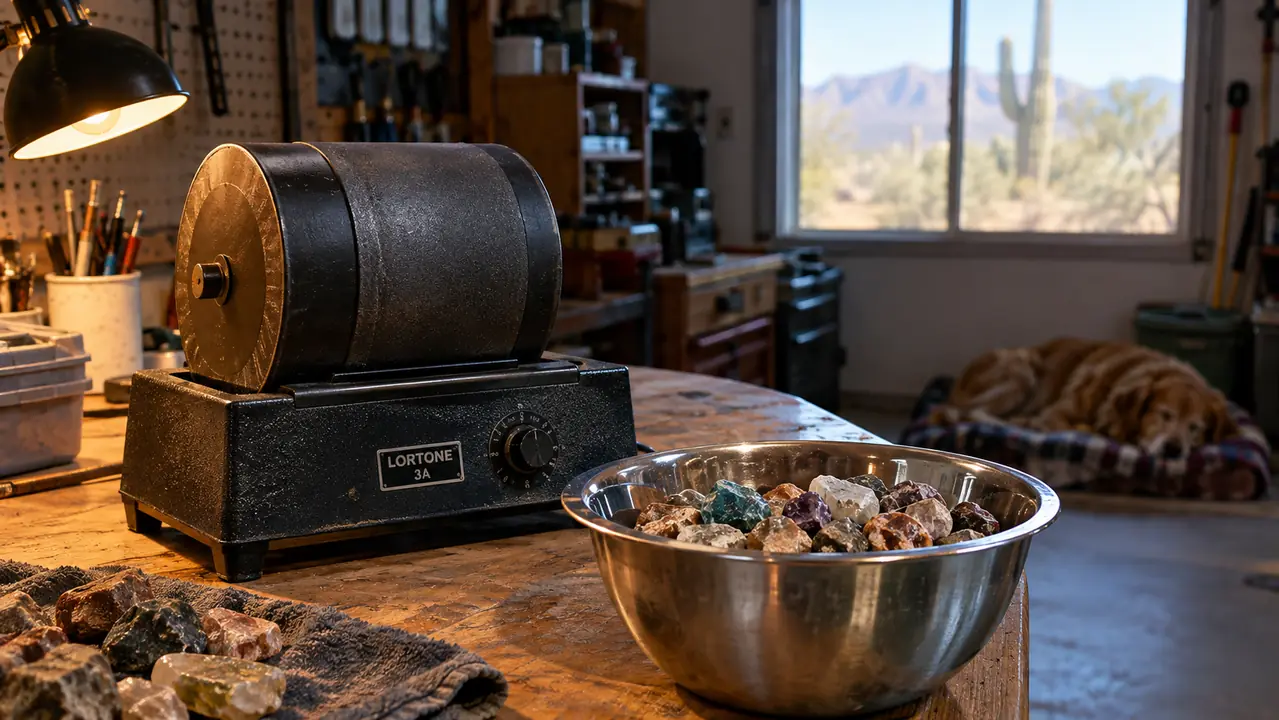
I have been tumbling rocks in my Tucson garage for about twelve years, and I still buy rough stone mixes the way some guys buy lottery tickets. You know what I mean. The listing shows a pile of glossy gems, you order a bag, and three weeks later you are holding a colander of rocks that look like the driveway. The UFEEL rough stone mix is not that bag. It is also not the bag the listing photos suggest. The truth sits somewhere in between, and that is what this review is about.
I ran two 3-pound batches of the UFEEL rough stone mix through my Lortone 33B over the course of a year, one batch of 1-inch stones and one batch of smaller fragments, and I kept notes on every stage. My wife Carol started hiding the notebook because I would read tumbler notes out loud at dinner. So before I say anything else, here is the short version.
The Quick Verdict
A fair mix of tumbling rough for the money, with maybe a third of the bag coming out worth keeping. Not the gem pile in the photos, but a solid starter batch if you set your expectations at the right height.
Amazon Check Today's Price →A 3-Pound Bag of Rough That Actually Tumbles
UFEEL 3 lb bulk rough stone mix, 1 inch natural raw crystals. A year of batches taught me this bag earns its keep. Check today's price on Amazon.
Amazon Check Today's Price on Amazon →How I Used It
I bought two 3-pound bags of the UFEEL rough stone mix in the spring, one for a dedicated 1-inch batch and one to top up a barrel that had run low. The bag claims natural raw crystals around 1 inch, and that part is roughly honest. Most stones ran from about three quarters of an inch to an inch and a quarter, with a handful of smaller pieces at the bottom. A few were closer to 2 inches and had to be set aside. Not a problem for me, I have a second barrel, but worth knowing if you only own one tumbler.
I started the first batch on a Tuesday in late March, the week after the Tucson gem show closed. I dumped the bag onto the workbench and sorted the whole thing by size before anything went into the barrel. That sorting session took about forty minutes and it is the step most beginners skip. The 2-inch pieces went into a separate jar for the big barrel. The small fragments at the bottom, maybe a quarter of the bag, went into a second jar to run on their own. What was left, about half the bag, was the honest 1-inch material that could all ride together. Sorting first is the difference between a good batch and a noisy, uneven one.
I ran each batch through the standard four stages: coarse 60/90 silicon carbide for seven days, fine 120/220 for five days, pre-polish 500 for five days, and polish with aluminum oxide for seven days. Tucson tap water is hard, so I used a pinch of borax in the polish stage. My garage stays warm most of the year, which helps. The dog, Biscuit, naps on a blanket in the corner and only woke up when the barrel rattled louder than usual, which was my cue to check the load.
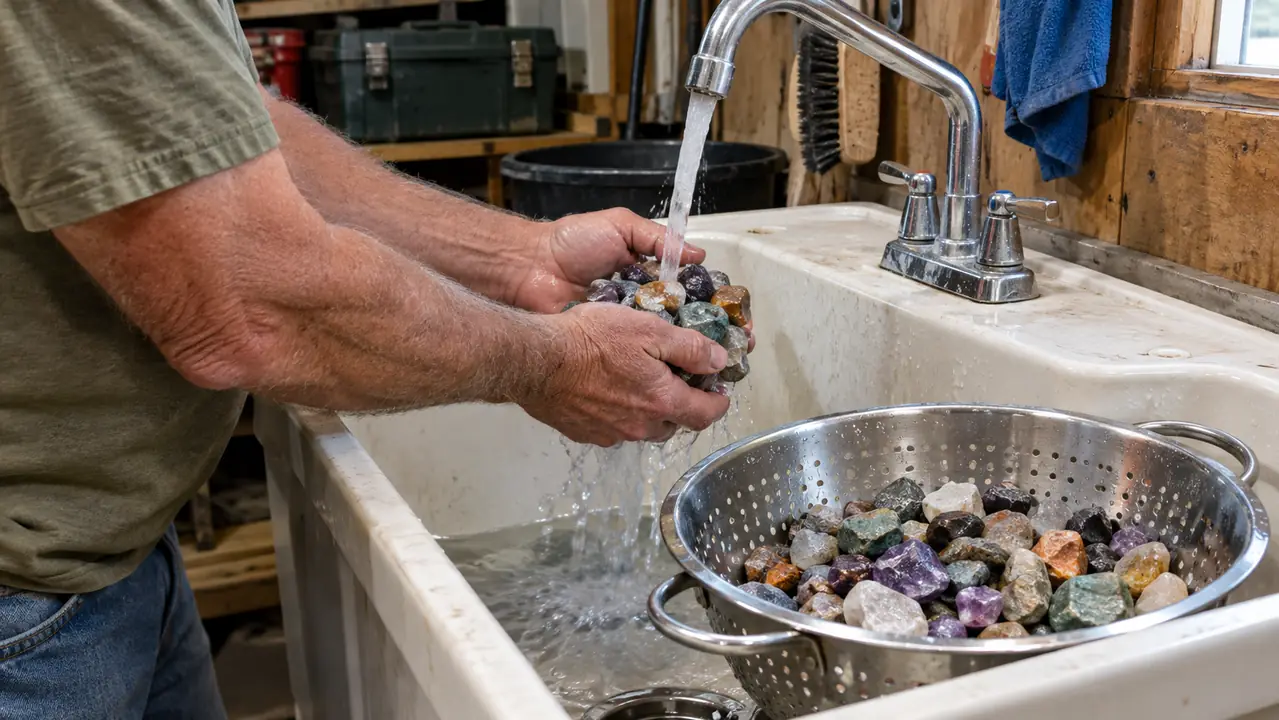
For the 3-pound load I used two level tablespoons of grit per pound of stone, so six tablespoons of 60/90 for the coarse stage, and I cleaned the barrel and stones completely between stages. That cleaning is tedious and it matters more than the grit. Any grit left over from the coarse stage will scratch the polish stage and you will blame the stones for something you did. I rinsed each stone by hand under the utility sink, which takes about twenty minutes a stage.
A note on the mix itself. UFEEL does not tell you exactly which stones are in the bag, and after a year I still cannot give you a complete list. What I can tell you is what tumbled well, what did not, and what the listing does not mention. That is the part of this review nobody else seems to write.
I started the second bag in July, when the garage runs close to ninety degrees in the afternoon. Warmth actually helps the grit cut faster, but it also makes the slurry dry out if you let a barrel sit too long between checks. I opened the lid every other day and added a splash of water when the load looked thick. Nothing in the UFEEL mix reacted badly to the heat, which is more than I can say for some premium rough I have run in the same barrel.
What Nobody Tells You About the Mix
First, the bag is heavier on quartz family stones than the photos suggest. You will see rose quartz, clear quartz, amethyst chips, and a lot of what I would call plain white quartz. That is not a bad thing. Quartz is forgiving in a tumbler and takes a good polish. It just is not the exotic assortment the listing implies. If you are buying this bag for variety, you will be disappointed. If you are buying it to learn the hobby, it is almost ideal.
I kept a tally on the second bag, out of curiosity more than anything. Forty-one stones total. Seventeen were some form of clear or white quartz, nine were rose quartz, six were amethyst chips, three looked like agate to me, and the remaining six were unknowns I could not name with any confidence. That is not a complaint. It is a census. If you want a labeled assortment, this is not the bag. If you want a fair sample of what the hobby feels like, the mix is about right.
Second, some stones arrive with cracks you cannot see until they come out of the barrel. I had two pieces that looked perfect going in and came out as gravel. That is the nature of rough stone, and no seller can guarantee against it. What matters is how the seller handles it. UFEEL does not promise a perfect bag, and I did not get one. I also did not get a bag of useless rocks.
The worst loss was a piece the size of a walnut that I took for carnelian, a deep orange-red stone with a waxy shine. It was the prettiest thing in the bag. On day three of the coarse stage I heard the barrel change pitch, a sort of soft ticking that is never good. When I opened it, that stone had broken into twelve fragments. The rest of the load was fine. I have learned to hold questionable stones up to a bright work light and look for hairline fractures before they go in, and I still miss them. Hidden cracks are part of the bargain with any rough stone, at any price.
Third, and this is the one I wish someone had told me: the 1-inch size is a compromise. Large stones take longer to shape and need more coarse grit per batch. The smaller pieces at the bottom of the bag will finish faster and can leave the big ones under-polished if you mix them. I ran them separately and got better results. Plan for a sorting session before you start, not after.
On my first run I did not sort, and the small fragments came out of the coarse stage round and ready while the big stones still had their original faces. I had to pull the small ones out, set them aside, and let the big ones run an extra three days. That is a week of barrel time wasted on a mistake that a quick sorting session would have prevented. The bag is not at fault. I just wish the listing said, sort this before you start, because every beginner will try to skip it.
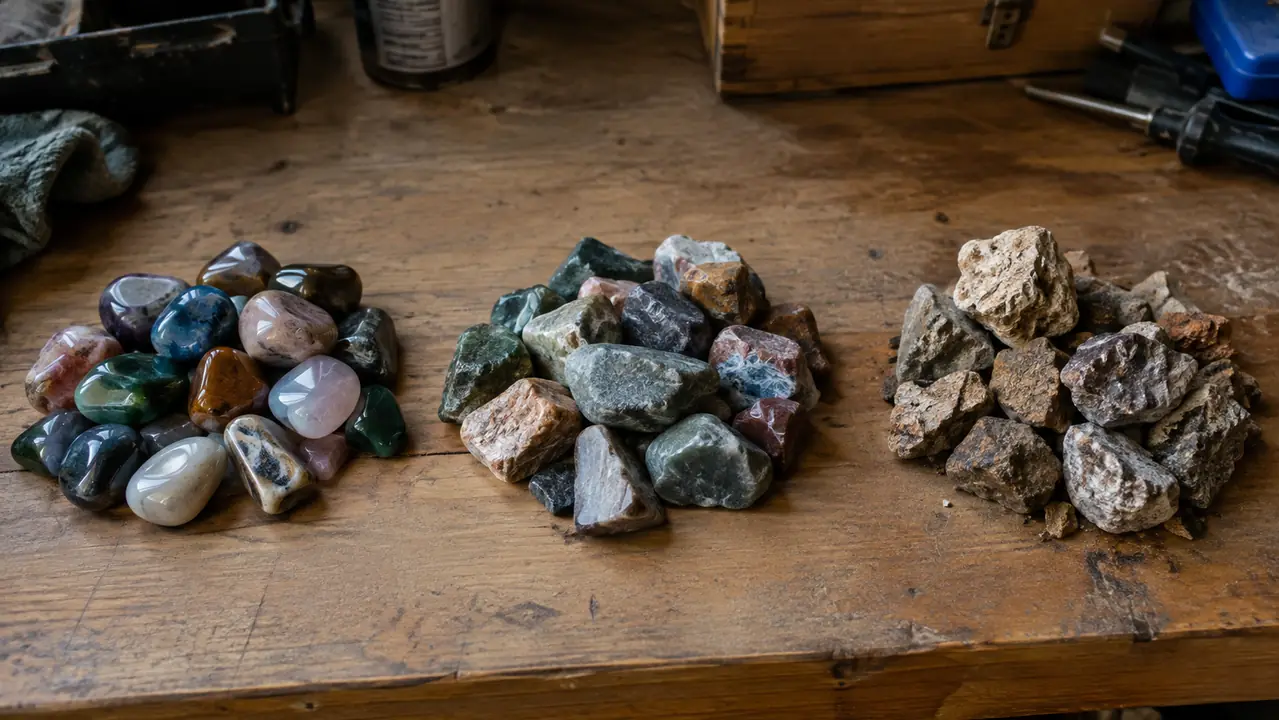
After a full four-stage run, maybe a third of the bag came out with a finish I would put in the display cabinet. Another third was decent. The rest is still sitting in a jar waiting for round two.
Performance Over a Year of Batches
Across two 3-pound bags, I kept a rough count. Out of roughly 40 stones per bag, about 12 to 15 came out glossy enough for the display shelf. Another 12 to 15 came out presentable, good enough for the garden or a gift bag. The rest were either too fractured, too soft, or too plain to bother with. That sounds like a low hit rate until you price it per stone. A 3-pound bag of the UFEEL rough stone mix costs about the same as a single polished stone at the Tucson gem show, and you get forty chances instead of one.
The two bags were not identical. The first gave me 14 keepers out of 39 stones, including the best rose quartz I have ever gotten from a bargain mix, a piece about an inch across with a deep pink center that catches the morning light. The second gave me 11 keepers out of 41, but that bag had more amethyst and the amethyst was uniformly good. The second bag also had more of the soft chalky stones, which tells me the mix varies from bag to bag more than the listing lets on.
The rose quartz in the bag tumbled beautifully. I got a handful of pieces with a soft pink glow that Carol now keeps in a bowl on the kitchen windowsill. The amethyst chips were smaller than I expected, but the ones that survived the coarse stage took a nice polish. The clear quartz came out glassy, as clear quartz always does if you are patient.
One clear quartz piece came out so clean that a friend asked if I had bought it polished. I had not. It spent seven days in coarse, five in fine, five in pre-polish, and seven in polish, and it came out looking like a lens. That is the moment that keeps me in this hobby, and this bag produced it from a stone that cost me almost nothing.
The weak spots were the softer stones. A few pieces that looked like calcite or a similar soft mineral turned chalky and dull no matter how many days I gave them. The white quartz was reliable but boring. And two stones that I suspect were some kind of fracture-heavy material simply fell apart in the barrel. That is not a defect in the product. It is a lesson in how tumbling works, and this bag taught it to me at a fair price.
The chalky ones went into the garden border, where they look fine among the gravel. That is where every failed batch ends up in my house, and I have a nice border because of it. The jar of stones waiting for round two sits on the shelf above the tumbler, maybe fifteen pieces between the two bags. I will run them again next winter with a fresh coarse stage and see if a second pass brings out anything the first one missed.
The Noise Question, Because Everyone Asks
Rock tumblers are loud. The UFEEL rough stone mix does not make them louder or quieter, but the size of the stones matters. The 1-inch pieces in a 3-pound load will rattle more than a barrel of small tumbling rough. Biscuit, my red heeler mix, hates the loud rattling and will relocate to the far side of the garage when a batch is in the coarse stage. I keep the tumbler on a folded rubber mat on the workbench and run it in the garage with the door closed. If you live in an apartment or share walls with a light sleeper, put the tumbler somewhere you can close a door.
One night in April, Biscuit got up from his blanket in the middle of the coarse stage, walked to the garage door, and just stood there staring at me until I checked the barrel. The load had shifted and one of the larger stones was riding on top, slapping the lid with every rotation. I stopped the barrel, added a spoonful of 60/90 grit and a splash of water, and the noise settled back to a steady rumble. He went back to his blanket. The dog knows the difference between a healthy rumble and a problem, and I have learned to listen when he tells me.
That is practical advice, not a complaint about the product. Every rock tumbler makes noise, and every batch of rough stones has to go through the loud stage. The UFEEL mix did not cause the noise, but I want you to know what you are signing up for before you buy.
For what it is worth, the noise gets better after the coarse stage. The fine, pre-polish, and polish stages are quieter because the stones have rounded off and the grit is finer. If you are new to the hobby, do not judge the hobby by the first week of the first batch. The first seven days are the loudest, and they are also the days when nothing looks like it is working. It is all working. You just cannot see it yet.
Who This Is For
This bag is for the beginner who wants to learn the full tumbling process without spending a fortune on premium rough. It is for the hobbyist who wants a reliable supply of quartz that will not waste a month of barrel time. It is for anyone who enjoys sorting stones almost as much as polishing them. I do. I spent a pleasant evening at the workbench with a cup of coffee, sorting each bag into size piles, and that is part of the hobby for me.
It is also for the person who wants to practice before buying the good stuff. Run a bag of UFEEL through a few cycles, learn how your tumbler behaves, make the mistakes, and then spend real money on premium rough once you know what you are doing. I ruined more than one batch of expensive stone in my first year. This bag would have been a cheaper classroom.
Who Should Skip It
Skip this bag if you expect the polished pile in the listing photos. No rough stone mix looks like that straight out of the bag, and this one is no exception. Skip it if you want a precise, labeled assortment of specific crystals. UFEEL sells a mystery mix, and the mystery is part of the appeal. Skip it if you are impatient. This bag rewards people who run the full four stages and do not peek.
And skip it if you only want display-grade results. You will get some, but you will also get a jar of stones that need another round or a trip to the garden. For my money, that is an honest trade. I would rather pay less per bag and sort through the results than pay three times as much for a bag that promises perfection and delivers the same mix of winners and losers.
What I Liked
- Fair price per stone, especially for beginners
- Quartz family takes a good polish
- Bag is heavier on usable rough than the photos suggest
- Good size range for learning how your tumbler behaves
- No filler that I could identify, no plastic, no dyed material
Where It Falls Short
- Listing photos imply more variety than the bag delivers
- Some stones arrive with hidden cracks
- Soft stones in the mix turn chalky
- Size range needs sorting before you start
- No list of what is actually in the bag
The Honest Verdict After a Year of Batches
The UFEEL rough stone mix will not give you a bag of gems, but it will give you a fair pile of tumbling rough at a fair price. Check today's price on Amazon.
Amazon Check Today's Price on Amazon →