
I have tumbled rocks in my garage in Tucson for about twelve years, and the one thing I have learned is that the grit does the work and the hobbyist stays out of the way. The National Geographic Grit and Polish Refill Kit from Blue Marble is the kit I have ordered more times than any other, so it deserves an honest review instead of the usual cheerleading. Here is the part nobody tells you: this kit will not make your rocks shiny by itself. It is abrasive in four stages plus a polish, and every batch you run eats a good portion of it.
I have gone through enough of these kits to ruin a few batches with my own shortcuts. I have put soft rocks in the barrel and watched them dissolve into paste. I have skipped the scrub between stages and pulled out frosted stones. Every one of those failures taught me more about tumbling than the successes did, and this review covers what I wish someone had told me before I started, the good and the bad, with nothing polished up for the sake of a rating.
The Quick Verdict
A dependable four-stage grit set that will polish your rocks if you do your part. The failures people blame on it are almost always barrel habits, not the grit. The fine grit and polish run out faster than you expect, so plan the reorder before you need it.
Amazon Check Today's Price →The refill kit I keep coming back to
Four stages of grit plus the polish in one box, ready for the tumbler you already own. Check today's price on Amazon and see what a full batch actually costs to run.
Amazon Check Today's Price on Amazon →How I've Used It
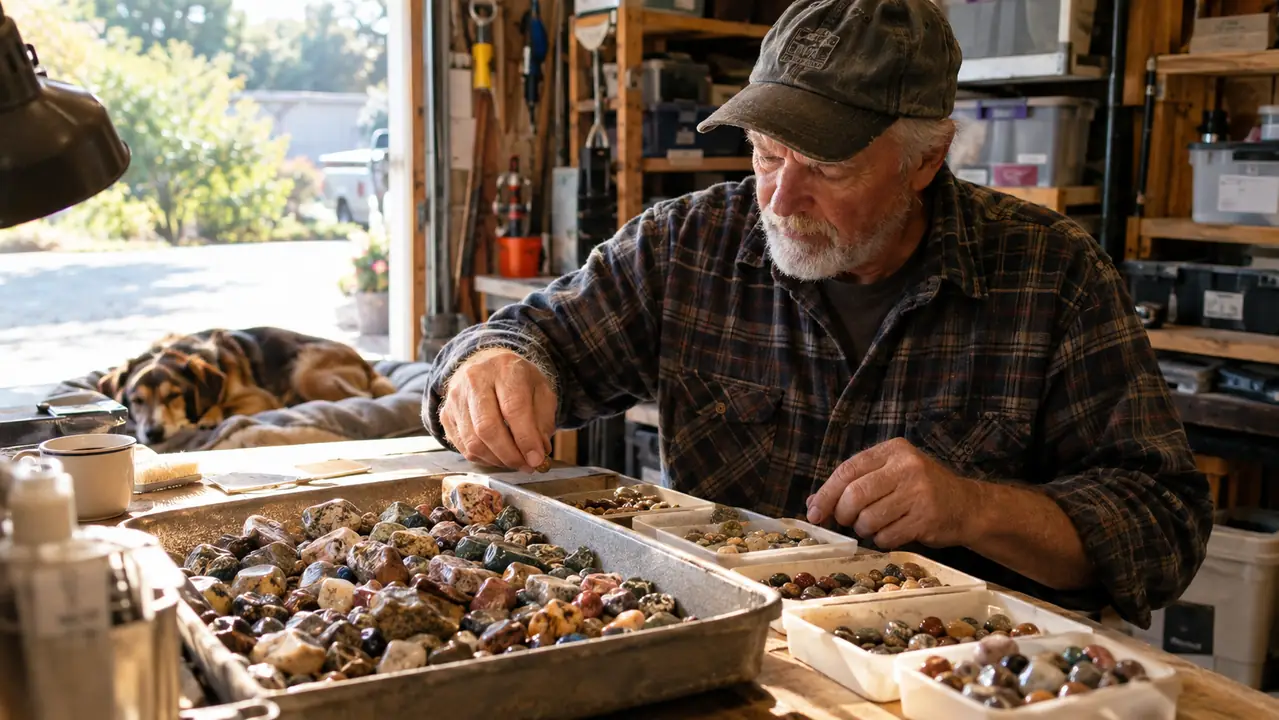
My setup is nothing special. A workbench with a utility sink in a detached garage, a tumbler on a shelf at the far end, and a rubber mat under it because the rattle travels straight through the bench. Biscuit, our nine-year-old red heeler mix, naps on a blanket by the door and hates loud rattling noises, so the shelf placement is not a decoration. It is a compromise, and Biscuit wins.
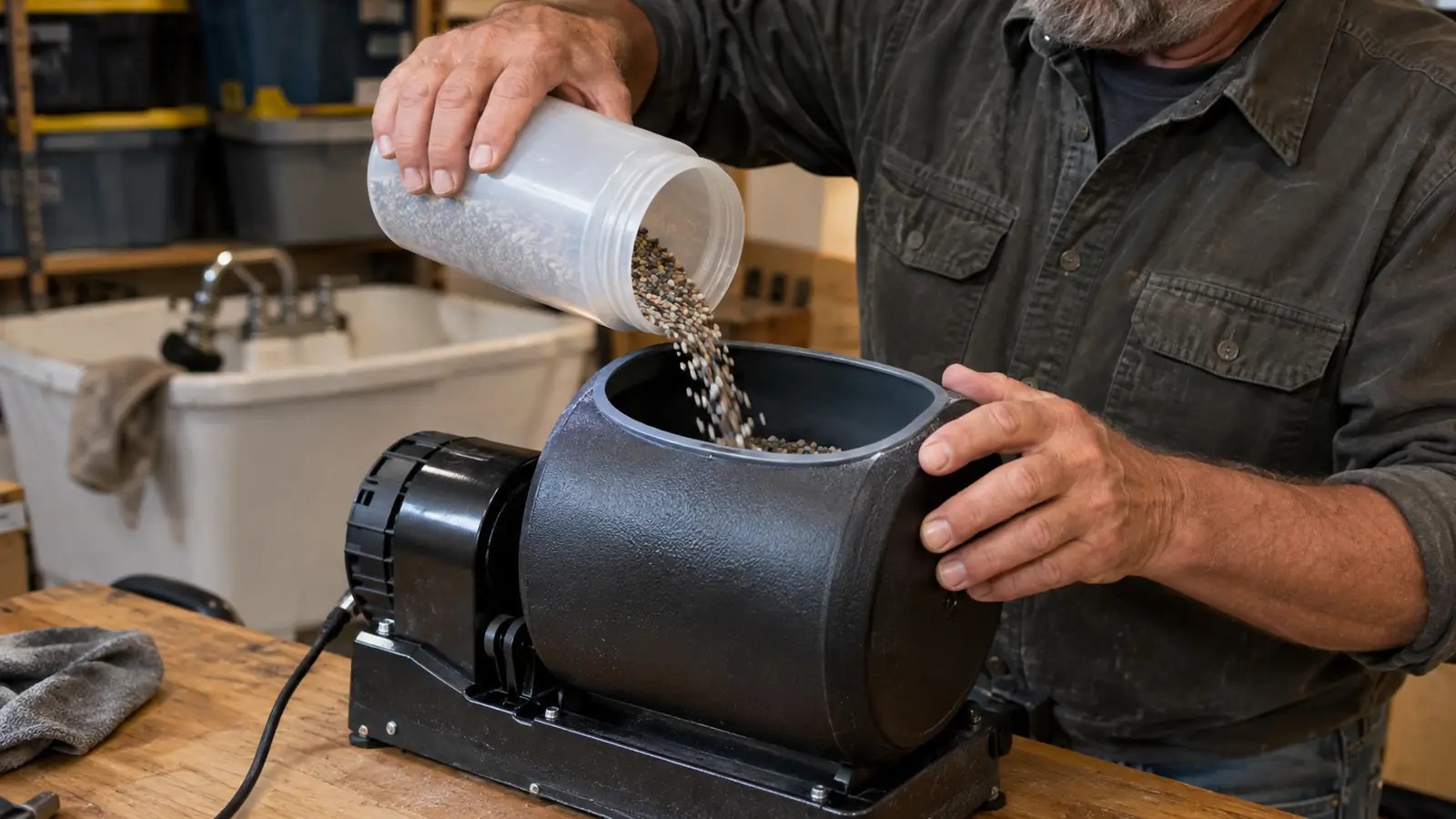
I sort rocks from desert washes and creek beds on day trips, and I bring home a box of rough from the Tucson gem show every winter. When I run a batch with this kit, I fill the barrel about two-thirds full, add water until it just covers the rocks, and pour in the coarse stage grit. Then I let it run seven days and do not peek. Peeking is how you convince yourself the rocks are done when they are not.
After seven days I drain it, rinse the rocks, scrub the barrel with the brush at the utility sink, and start the next stage. That scrub between stages is the whole ballgame. The kit has been through that routine about a dozen times at my bench in the last few years, and the results have been steady. That is the honest basis for this review: a dozen batches, a few ruined by me, most of them better than anything I produced in my first year of tumbling.
What the Kit Actually Is (and Isn't)
First, the plain description. This is a refill, not a tumbler, and not a fix for bad habits. If you bought a starter tumbler and used up the little packets that came with it, this is the next purchase. It covers the four stages you need: coarse, medium, fine, and the polish. Nothing more, nothing hidden, and that is a good thing.
What nobody tells you is how unevenly those stages get used. The coarse and medium go slowly. The fine stage and the polish go fast. After two full batches the fine grit bag is noticeably lighter, and the polish is the first thing you will reorder. Plan for that and you will not be stuck at stage three with an empty bag and a barrel full of rocks that are only halfway there.
The kit is made by Blue Marble, the company behind the National Geographic tumbling line, and my batches have been consistent across several reorders. The boxes have changed over the years, but the grit inside has behaved the same every time. For a consumable product, consistency is the whole point. You want the same cutting action from the same stage, batch after batch, and that is what this kit delivers.
One more honest note about the box: it assumes you know the basics. The instructions are thin, and if you are brand new, the tumbling forums will teach you more than the paper will. That is not a dealbreaker for me, because the process is simple once someone shows you, but it is the kind of thing the marketing photos never mention.
The Part Nobody Tells You About Grit
Grit is crushed silicon carbide, and it works by wearing the rock down. It does not dissolve like soap, and it does not get used up. It gets dull. The sharp edges round off, the particles break into finer dust, and after a week in the barrel it is spent. People try to reuse it, and that is the first mistake I see in every beginner forum. Spent grit is just dust with a little rock mixed in, and it will not cut anything.
The second mistake is water. Too much water and the rocks slosh while the grit settles on the bottom, so the batch comes out barely changed. Too little water and the slurry turns to paste, the barrel labors, and you risk stalling the motor. My rule has not changed in twelve years: fill the barrel two-thirds with rocks, then add water until it just covers them. That ratio works with this kit and with every other grit I have tried.
The third mistake is time. Each stage wants a full week, and the polish stage wants a scrupulously clean barrel. Not rinsed. Clean. Any grit left from the fine stage will scratch the polish and leave you with frosted rocks. I have made that exact mistake, and it was never the kit's fault. The grit did its job. I failed to do mine, and the rocks showed the difference.
The fourth thing nobody mentions: pour the grit slowly and keep your face back. Fine grit throws up a dust cloud if you dump it, and silicon carbide dust is not something you want in your lungs. I pour over the sink with the water running, and a cheap dust mask sits on my shelf. That advice cost me nothing and saved me a lot of coughing. The kit does not warn you about this, and it should.
Every dull batch I have ever pulled out of that barrel came from a dirty barrel, too much water, or a stage I was too impatient to finish. The grit was never the problem.
Where I Ruined Batches (So You Don't Have To)
I will give you three honest failures. First, the dirty barrel. I ran the fine stage, dumped it, rinsed the rocks, and put them straight into the polish without scrubbing the barrel. The batch came out looking like frosted glass. I blamed the polish until I ran the same polish in a clean barrel and got a shine. The lesson stuck, and I have scrubbed religiously ever since.
Second, the soft rock. I tossed a piece of calcite from a desert wash into a batch because it looked pretty. It dissolved into a white paste and coated every other rock in the barrel. The grit was fine. My rock selection was not. Soft rocks do not belong in a tumbler, and no refill kit can fix that. Now I test an unknown rock with a steel file before it goes anywhere near the barrel.
Third, impatience. I cut a coarse stage to four days because I wanted to see progress. The medium stage then had to do work the coarse stage should have done, and the batch came out lumpy and dull. I have not done that again. This kit rewards patience, and that is the honest review in one sentence. If you follow the four weeks, the rocks come out looking like the photos. If you cheat the process, they come out looking like you cheated.
The pattern across all three failures is the same, and it is worth saying plainly: the grit kit was never the variable. The variable was me. Once I accepted that, my batches improved more than any product change could have delivered. That is the most useful thing I can tell you about this kit or any other.
The Polish Stage Is Where It Pays Off
The polish is the stage that separates a nice hobby from a frustrating one, and it is the stage most people rush. After the fine stage, the rocks should feel smooth but not glossy. The polish step is what puts the shine on, and it asks for two things: a clean barrel and a full seven days. Give it both and you will get a surface that reflects the garage light.
One trick I learned the hard way: after the polish stage, run the rocks for a few hours with a squirt of dish soap and fresh water. It rinses off the polish residue and leaves the stones with a cleaner finish. The kit does not mention this, and it is not required, but it is the difference between good and great on a batch of agates.
The polish in this kit has been consistent for me, which matters because polish is where cheap kits cheap out. If the polish is too coarse, you never get a shine. This one cuts and then finishes, and my finished batches have a gloss I did not get from the starter kit packets. That is the stage where the honest review turns positive.

Alternatives I Have Tried
For the sake of honesty, I have bought grit in bulk from lapidary suppliers, and I have tried the competing kits from other brands, including Polly Plastics. Bulk grit is cheaper per pound, no question, and if you tumble constantly it is the economical road. The catch is that you buy four separate stages, store four open containers, and hunt down a polish that behaves. For a hobbyist running a few batches a year, that is a lot of management for a small saving.
The Polly Plastics kit works, and I have used it. The grit stages are similar, and the results are comparable. What keeps me coming back to Blue Marble is the one-box simplicity and the polish. I know exactly what I am getting, and I can reorder the same thing without thinking. That matters more to me at sixty-one than saving a few dollars on a bag of coarse grit.
The honest tradeoff: if you tumble every week, bulk grit from a supplier will save you money, and you should do that. If you tumble the way most people do, a few batches at a time between other hobbies, this kit is the better fit. It costs a little more per batch and saves you the mental overhead. I have made both choices at different times, and this is the one I reorder.
If you are comparing kits in your head right now, the honest answer is that most of them will get you to a finished stone. The differences are in the polish, the packaging, and the consistency between batches. This kit wins on consistency and loses on price per pound, and I have made peace with that trade because my time is worth more than the difference.
What I Liked
- Four complete stages in one box, coarse through polish
- Consistent results batch after batch across several reorders
- Sealed bags hold up in a hot, dry garage without clumping
- One-box simplicity, easy to reorder the same thing
Where It Falls Short
- The fine grit and polish run out faster than beginners expect
- No instructions on barrel cleaning between stages, where most failures start
- Spent grit cannot be reused, so the cost adds up for constant tumblers
- It is a refill only, easy to mistake for a full starter kit if you do not read the box
Who This Is For
This kit is for the person who already owns a tumbler and wants to keep running batches without hunting down each stage separately. It is for the beginner who has finished the starter packets and wants the next four weeks to go smoothly, and for the long-timer who just wants a dependable reorder. If you are willing to wait a week per stage and scrub the barrel between stages, this kit will do exactly what it promises.
It is also for the person who wants the same results twice. Tumbling is a hobby of repetition, and the quiet pleasure of it is watching a routine turn a rough stone into something you want to keep. This kit fits that routine. It does not surprise you, and in a consumable supply, that is the highest compliment I can give.
Who Should Skip It
Skip it if you are still deciding whether tumbling is for you. The starter kit packets are enough to answer that question, and there is no point buying a four-stage refill for a hobby you have not committed to yet. Skip it if you are not willing to clean the barrel between stages, because no grit on the shelf will fix a dirty barrel.
Skip it if you expected a complete setup, because this is a refill and the box says so plainly. And if you tumble every single week, bulk grit from a lapidary supplier will treat your wallet better. This kit is the right tool for the regular hobbyist, not the production shop, and knowing the difference is half the battle.
The Bottom Line
The National Geographic Grit and Polish Refill Kit from Blue Marble is a solid, honest product that does exactly what it claims. It is not magic, and it will not fix a dirty barrel, a soft rock, or a hobbyist in a hurry. What it will do is deliver the same four stages, the same cutting action, and the same polish, batch after batch, for as long as you follow the routine.
I have ruined my share of batches, and every one of them taught me something the box did not say. That is the real review: the kit is dependable, the instructions are thin, and the rest is up to you. For twelve years of tumbling, that is a fair trade, and it is why I keep a spare in the plastic bin.
Ready to run a batch the right way?
Four stages of grit plus the polish that finishes the job, in one reorder from Blue Marble. Check today's price on Amazon, and scrub that barrel before the polish stage.
Amazon Check Today's Price on Amazon →