
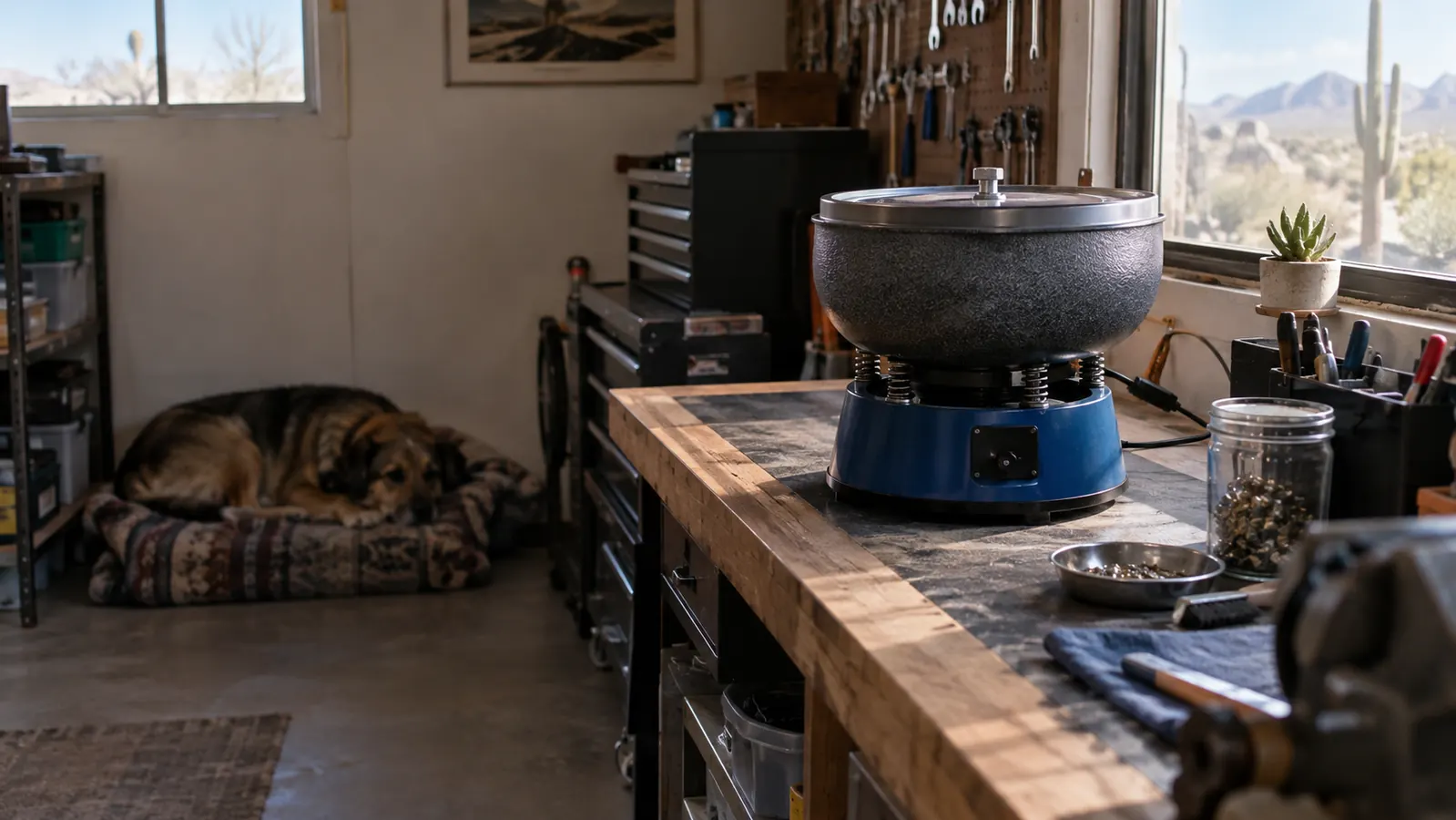
The first time I ran a Raytech TV-5, I stood there like a man watching a pot that refuses to boil. Twelve years of tumbling rocks in this Tucson garage, and I still expected a vibratory tumbler to behave like my old rotary. It doesn't. It hums instead of thumps, and it works in days instead of weeks. That difference is the whole story, and it took me a while to trust it.
My name is Gary Lindahl. I'm 61, a retired machinist, and my wife Carol will tell you I spend more time at the utility sink than I do in the kitchen. My red heeler mix, Biscuit, naps on a blanket in the corner of the garage, and he only stirs when something rattles. That matters more than you'd think, because a rotary tumbler rattles all night, and a vibratory tumbler mostly just hums.
This article is not a lab report. It's what I learned running the Raytech TV-5 on weekend batches through a winter of desert washes and creek beds, plus a few stones I picked up at the Tucson gem show. I ruined my share of batches along the way, and I'll tell you about those too, because that's the part of a review that usually gets left out.
If you've only ever used a rotary tumbler, the Raytech TV-5 will surprise you. It's a vibratory machine, which means the bowl shakes the stones and media in a constant motion instead of rolling them in a barrel. The result is faster polishing, quieter operation, and a different set of habits you have to learn. I learned most of mine the hard way.
The first batch I ran in the Raytech TV-5 came out in four days looking like it had spent a month in my old rotary. That's when I stopped treating it like a machine and started treating it like a different way of working.
Ready to see what a weekend can do?
The Raytech TV-5 is the vibratory tumbler I keep coming back to for fast, quiet finishing. Check today's price on Amazon and see if it fits your workbench.
Amazon Check Today's Price on Amazon →The first thing you notice is the noise, or rather the lack of it. My old rotary sounded like a dryer full of boots. The Raytech TV-5 sits on the bench and hums, a low steady note that Biscuit ignores completely. That alone changed when I could run a batch. I used to start the rotary in the morning and hope it finished before Carol wanted to use the patio. Now I start the Raytech after breakfast and check it after lunch.
The second thing you notice is the speed. A rotary tumbler needs weeks to move stones through coarse grit, fine grit, pre-polish, and polish. The Raytech TV-5 does the same work in days, sometimes in a single weekend. The tradeoff is that you have to check it more often, because vibratory tumbling works fast enough to go wrong fast. Leave it too long and you'll round off the very edges you were trying to keep.
I learned that lesson on a batch of moss agate from a wash north of town. I set the Raytech TV-5 up on a Friday, figured I'd let it run through Sunday, and came out to find stones that looked like smooth river pebbles. Pretty, but not what I wanted. The machine wasn't the problem. My schedule was. The Raytech TV-5 rewards attention, and once I gave it that, it rewarded me.

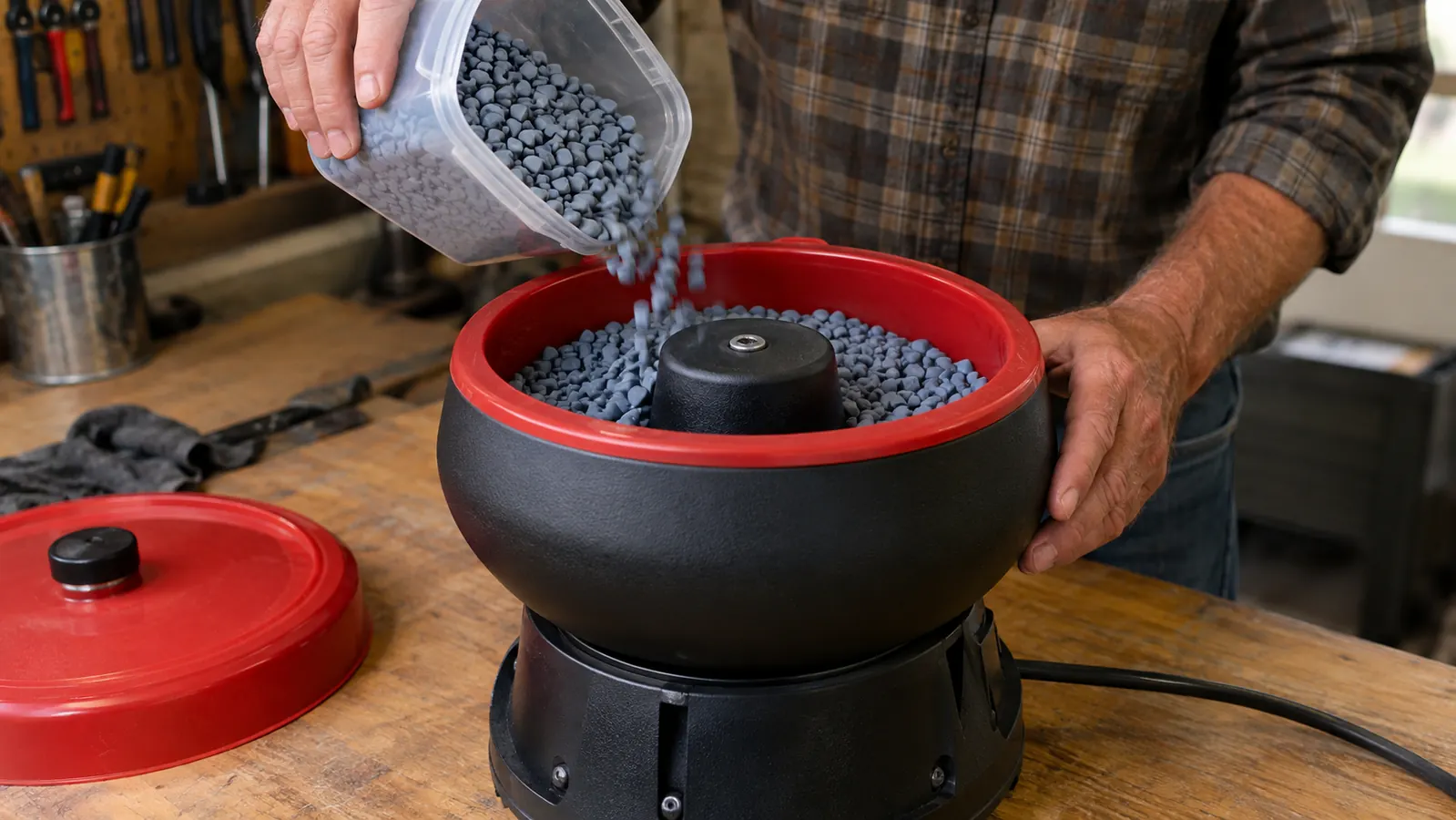
The bowl is the other thing worth knowing about. The Raytech TV-5 uses a plastic bowl with a drain plug, and the vibratory action keeps the stones and media moving in a constant swirl. You use less grit than a rotary, and the media does more of the work. I keep a bag of plastic pellets on the shelf next to the machine, and I've learned to match the media to the stone. Soft stones get soft media. Hard stones get a firmer mix. That's the kind of detail that separates a good batch from a ruined one.
By the end of that winter, I had a system. Small batches of agate, jasper, and petrified wood went into the Raytech TV-5 on Saturday morning. I checked them Saturday evening, changed the grit Sunday morning, and pulled them Sunday afternoon. A batch that used to take my rotary three weeks came out in a weekend, and the polish was better because the vibratory action reaches the crevices a rolling barrel can miss.
What I'd Tell You If We Were Sitting at My Kitchen Table
If you were sitting at my kitchen table with a cup of coffee, here's what I'd say. The Raytech TV-5 is not a replacement for a rotary tumbler. It's a complement. I still use my rotary for big batches of rough stone that need weeks of shaping. I use the Raytech TV-5 for the finishing work, the stones I actually care about, the ones that deserve a weekend of attention.
I'd also tell you to read the instructions, which is advice I ignored and paid for. The Raytech TV-5 comes with a specific way to load the bowl, a specific amount of media, and a specific order of operations. Follow it. Once you understand why the machine works the way it does, you can start adjusting. Until then, you're just guessing, and guessing is how I turned a batch of nice agate into a bowl of pebbles.
And I'd tell you this: the Raytech TV-5 is the machine I reach for when I want to see a stone come alive. There's a moment, usually on a Sunday afternoon, when the last grit is washed off and the stone comes out of the bowl wet and gleaming. That moment is why I've kept tumbling for twelve years. The Raytech TV-5 gets me there in a weekend instead of a month, and it does it without waking the dog.
Give it one weekend
If you're tired of waiting weeks for a rotary barrel to finish, the Raytech TV-5 is worth a look. Check today's price on Amazon and see what a weekend of tumbling can do.
Amazon Check Today's Price on Amazon →