
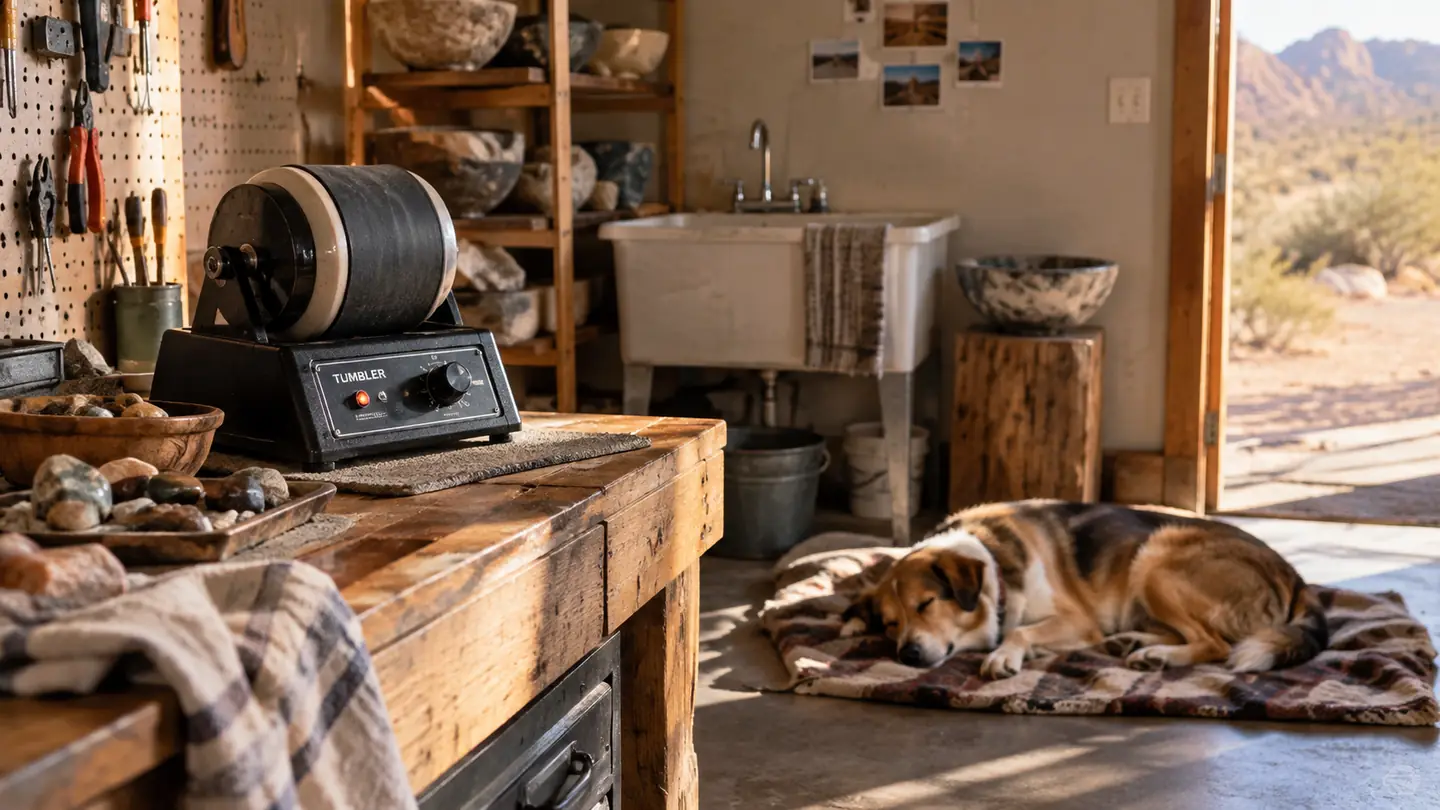
If you are trying to pick between the Raytech TV-5 vibratory tumbler and a rotary rock tumbler, the short answer is that they are not competing for the same job. A rotary shapes rough rock. A vibratory finishes it. I have run both on the same bench in my garage for the better part of twelve years, and I would not give up either one. But if you can only buy one right now, the choice comes down to a single question: are you bringing home rough stone that still needs shaping, or do you already have stone that is ready to polish?
The Raytech TV-5 is the machine I reach for when stones are already rounded and I want a polish worth showing at the Tucson gem show in February. A rotary, like the Lortone 3A that sits next to it on my bench, is what turns a jagged creek rock into something a vibratory can finish. One does the heavy lifting. The other does the fine work. That division of labor drives every row in the table below, and it is the reason most serious tumblers end up with both machines eventually.
| Raytech TV-5 (Vibratory) | Rotary Tumbler (Lortone 3A) | |
|---|---|---|
| Main job | Final shaping and polishing of stones that are already rounded | The full run, from rough rock to polish-ready stone |
| Time for a polish stage | 24 to 48 hours, often overnight | About a week per stage |
| Shaping rough rock | Weak. It refines a shape, it will not round a jagged stone | Strong. The coarse grind does the heavy lifting |
| Noise | A steady hum. My dog naps through it | A constant rattle that carries through the garage wall |
| Load size | About a five-pound bowl, best kept to three or four pounds of stone | A three-pound barrel that wants to be nearly full |
| Grit and media | Small amounts of fine grit. Ceramic media helps the slurry move | Coarse grit in bigger doses, plus water for every stage |
| Learning curve | A little picky about load and moisture until you get the feel | Load it, add grit and water, check back in a week |
| Best for | A second machine for the polish stage, or a fast finish | A first tumbler, or the only tumbler on the bench |
| Mess and cleanup | Less slurry, and it rinses out in the utility sink | Barrel lids, slurry, and a spot to dump and rinse grit |
| Machine type | Vibratory bowl | Rotating barrel |
Why the Two Machines Feel Different
The difference is in how the load moves. A rotary barrel turns the stones end over end, so every rock takes a beating from every other rock in the barrel. That is what grinds the corners off, and it is also why the process takes weeks. A vibratory tumbler shakes the bowl in a tight circular motion, so the stones slide against each other instead of falling. The action is gentler and faster at the same time, which sounds like a contradiction until you watch it run.
That difference explains everything else. Because the vibratory does not drop the stones, it does not round them. The edges you shaped in the coarse stage stay put. Because the load slides instead of falls, the fine grit actually gets a chance to work the surface, which is why a polish that takes a week in the barrel can be done in a day or two in the vibratory. Same grit, same stone, different motion, different result.
Where the Raytech TV-5 Wins
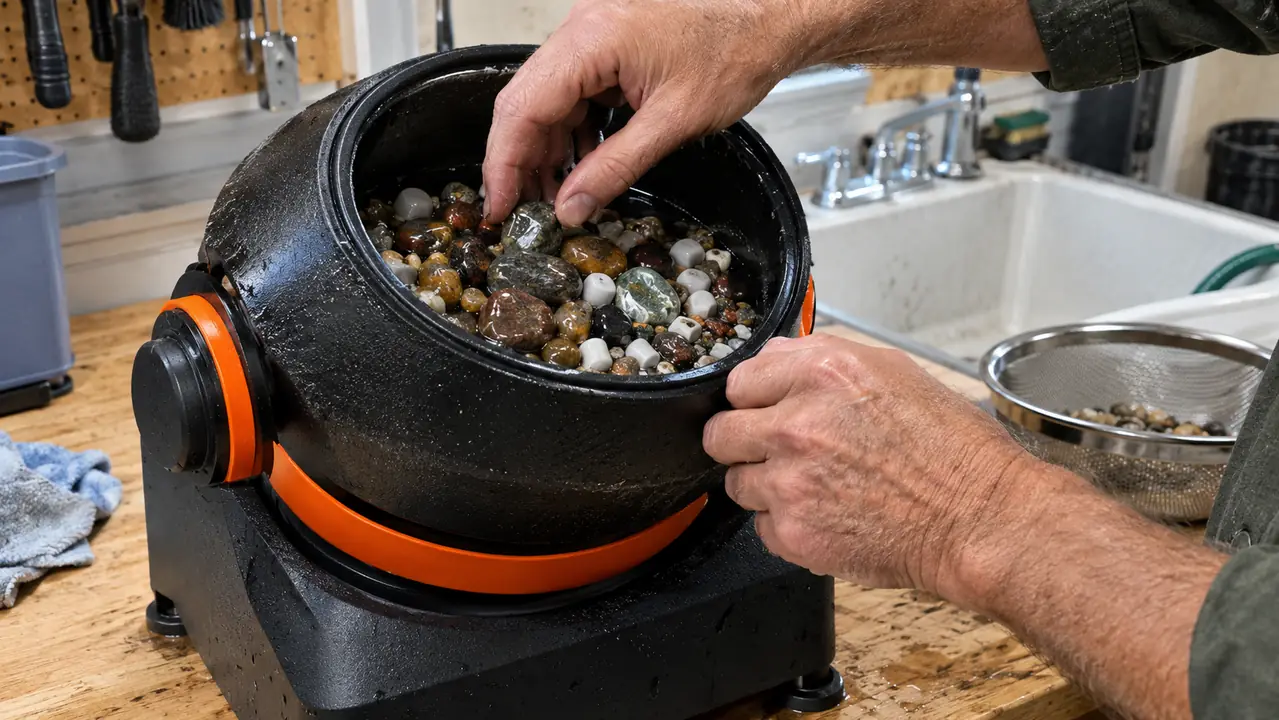
The reason most of us add a vibratory to the bench is time. A rotary polish stage runs about seven days. The same polish in the Raytech TV-5 runs overnight, sometimes two nights for a heavy load. I had a batch of moss agate from a wash east of Tucson go from fine grit to a dry shine in about thirty hours, and it did not lose the crisp edges I had shaped in the barrel. The vibratory moves the load in a tight circular path, so the grit works the whole surface at once. That is why the finish comes out even, with none of the bruising you get when stones slam end over end.
The other win is noise, and in my house that matters. Biscuit, our red heeler mix, naps on a blanket in the garage and hates the rattle of a rotary. The TV-5 hums. It is a lower, steadier sound, more like a small motor than a box of rocks, and the dog stays put through a full run. The finish is also more consistent because the load does not tumble. Stones keep the shape you gave them in the coarse and medium stages, which is exactly what you want when a stone is headed for a cab or a display case.
The ceramic media is part of the speed. A scoop of small ceramic pellets in the load fills the gaps between stones, so the grit keeps working even as the batch settles. Without media, the stones pack down and the polish stalls. With it, the load stays lively overnight. It is a small thing, but it is the difference between a thirty-hour polish and a three-day fight.
Where a Rotary Tumbler Wins
A rotary wins the part of the job nobody likes to admit they need: shaping. A vibratory will not round a jagged rock. It moves the stone in a circle and polishes whatever surface happens to be there. The coarse grind in a rotary barrel is what knocks the corners off a fresh creek rock. Over a week of coarse grit, a broken piece of jasper becomes something you can actually hold without cutting yourself. I have never seen a vibratory do that, and I have ruined batches trying to force it.
The rotary is also the more forgiving machine. You load the barrel, add water and grit, and check back in a week. The Raytech wants attention. It needs the right moisture, the right load, and a look every few hours on a long run. For a beginner, or for someone who wants one machine that does the whole job, the rotary is the honest answer. It will take stone from the desert wash to the display case, which is more than the TV-5 can claim on its own.
A rotary also handles a wider range of rock sizes in one load. A handful of mixed rough, from walnut-sized pieces down to gravel, all comes out shaped because the barrel tumbles everything together. The vibratory prefers a more uniform load, which means sorting before you run it. Sorting is fine when you are finishing a batch. It is a chore when you are just trying to work through a bag of creek finds.
A rotary does the shaping. A vibratory does the shine. I have ruined batches trying to make one do the other's job.
Already rounding stones in a barrel? This is the machine that finishes them overnight.
The Raytech TV-5 is the tumbler I reach for before every gem show. Stones that are already shaped go in, and a polish that would take a week in the barrel is done in a day or two.
Amazon Check Today's Price on Amazon →Who Should Buy Which
Buy the Raytech TV-5 if you already run a rotary and you are tired of waiting a week for the polish stage. It is also the right buy if you cut cabs, because a vibratory is the standard tool for finishing flat work without rounding the edges. If your collecting bags are full of stone that is already smooth, river tumbled or left over from a previous batch, the TV-5 will get you to a finished polish faster than anything else on my bench.
Buy the rotary first if you are new to tumbling and you want one machine that can take a pocketful of rough stone and return polished rock. The TV-5 will not do that alone, and no amount of fine grit changes the physics. A barrel is also the better buy if you like to run big loads of coarse material, because the vibratory works best with smaller batches and a light touch.
Start with the rotary, learn the stages, and add the Raytech later. That is the order most of us actually follow, and it is the order I recommend to anyone who asks at the gem show. The vibratory is not a replacement. It is the second half of the job.
How I Run Both on One Bench
My routine is simple. The Lortone 3A does the coarse grind and the medium grind, about two weeks total. Once the stones feel smooth and the surfaces are even, they move to the Raytech TV-5 for the fine grind and the polish. That split saves me about ten days per batch compared to running everything in the barrel, and the polish is better because the vibratory does not knock the stones around during the final stage.
The TV-5 has its quirks. I keep the load around three pounds of stone plus a scoop of ceramic media. Too much water and the slurry turns to mud and the stones stop moving. Too little and they bounce instead of sliding. You learn the feel after a few runs, the way you learn any machine. The bowl rinses clean in the utility sink, which is more than I can say for a barrel and its lid. That matters when Carol wants the garage sink back by dinner.

The Batch I Ruined and What It Taught Me
The first time I ran the TV-5, I filled it to the rim with wet stones and walked away for the day. I came back to a muddy mess. The stones were not moving, the fine grit had settled to the bottom, and it took me an hour at the utility sink to sort it out. The machine was fine. The operator was not. That is the honest review of every piece of equipment in my garage.
I also learned not to put soft stone in the vibratory. A piece of turquoise that would have survived the gentle end-over-end of the barrel came out with its faces bruised after a day in the TV-5. Soft material needs gentler media, and some material belongs in the rotary no matter how fast the vibratory is. Knowing which is which is the difference between a display tray and a bag of regret.
What the Specs Don't Tell You
The spec sheets will tell you capacity and speed, but they will not tell you how a machine fits into a Tuesday. The TV-5 sits on the bench ready to go, so I run it in the evenings while I sort the next batch. A rotary demands a week of patience and a place where the rattle will not drive the household crazy. Mine lives on a rubber mat in the corner, and I still close the garage door when it runs.
The other thing specs do not show is how often you will actually use each machine. The rotary runs for weeks at a time, but it only gets loaded a few times a month. The vibratory gets used almost every week, because it is the machine that turns a good batch into a finished one. On my bench, the TV-5 earns its place by being the last stop for every stone that matters.
What I'd Change About Each Machine
If I could change one thing about the TV-5, it would be the lid. The lid does its job, but I would like one that felt more secure when I carry the bowl to the sink. As it is, I move it carefully and it is fine. Minor gripes, and they are worth naming because every machine has them.
For the rotary, I would want a barrel that is easier to open and rinse. The lid does the job, but after a few years of grit it gets stubborn. A quick rinse under the utility tap and it is ready for the next load. Neither machine is perfect. Both are worth owning, and that is the honest bottom line.
What I'd Tell a New Tumbler
If you are standing in the aisle trying to decide, here is the plain version. The Raytech TV-5 is a finishing tool for someone who already understands the coarse and medium stages. It is fast, quiet, and easy to clean, and it will make your polish stage look like a different hobby. But it will not shape rough rock, and it will punish you if you overload it or walk away from a wet load. Treat it like the precision tool it is and it will treat your stones well.
The rotary is the workhorse. It is slow, noisy, and messy, and it will round a rock that the vibratory cannot touch. If you only ever buy one machine, buy the rotary. If you buy the vibratory first and feed it rough stone, you will be disappointed, and I would rather you learn that from this article than from a bag of ruined agate.
One more thing. Whichever machine you buy, keep a notebook. I write down the stone, the grit, the time, and the water for every batch. Twelve years in, that notebook is worth more than any tumbler I own, because it keeps me from making the same mistake twice.
The finish line for your next batch starts here.
If your stones are already shaped and you want a polish you can show off, the Raytech TV-5 is the machine that gets you there in a day or two instead of a week.
Amazon Check Today's Price on Amazon →