
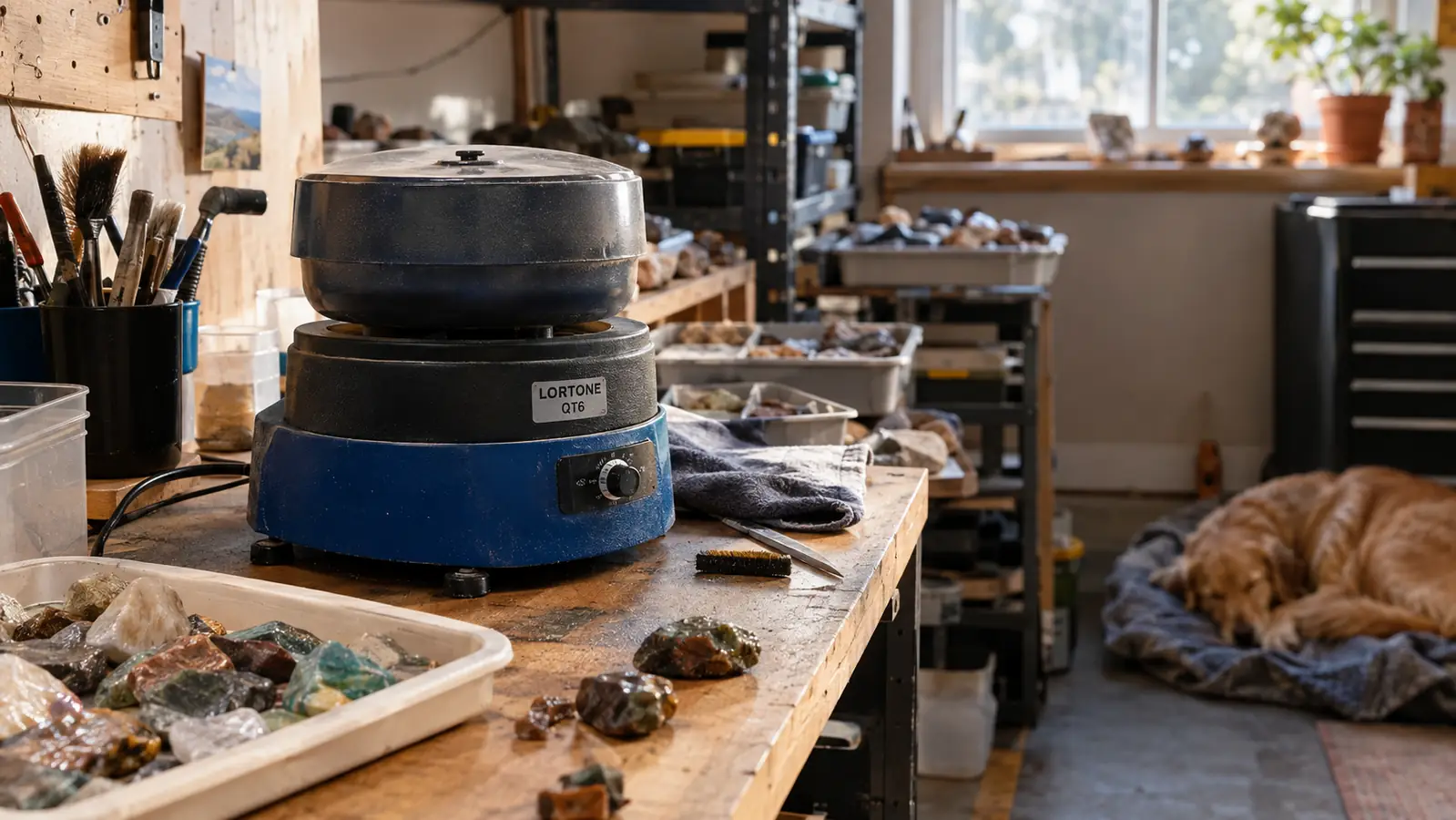
You can run a rock through a rotary tumbler for three weeks and still pull out a batch that looks flat. That was my problem for years. The stones came out shaped and smooth, but the shine never really arrived, and every attempt at a better finish meant another month of waiting before I could try again. About three years ago I got tired of the calendar and added a Raytech TV-5 vibratory tumbler to the garage bench for the finishing work. I have run it nearly every week since. This is the long-term report: what the machine does well, where it annoys me, and whether it earns the bench space next to my rotary.
Before the TV-5, I tried the usual workarounds. Extra fine grit in the rotary, longer cycles, burnishing with soap, even a second pass through the barrel. They helped a little, but the polish stage still ate two to three weeks out of every batch. The vibratory tumbler works on a different idea, and it took me a while to trust it. If you are standing where I was, wondering whether this machine earns the bench space, here is the honest answer after long-term use.
The Quick Verdict
The Raytech TV-5 turned my polish stage from a three-week wait into a one-to-two-day job, and after roughly two hundred hours of running time the motor still starts every time. It will not shape rough stone and it asks for daily attention, but as a finishing tool it is the best addition I have made to my bench in twelve years of tumbling.
Amazon Check Today's Price →Turn a Three-Week Polish Wait Into a Weekend Job
If your stone is already shaped and the finish stage is what keeps eating your calendar, the TV-5 is the machine to look at. It does one job and does it fast. Check today's price on Amazon and see if it fits your bench.
Amazon Check Today's Price on Amazon →How I've Used It
My setup has stayed simple since day one. The TV-5 sits on a rubber mat at the end of my garage workbench, a few steps from the utility sink where I rinse stone. The first Saturday in March, the weekend after the Tucson gem show closed, the first batch went in that afternoon. That first load was a mix of moss agates and jasper from a wash north of town, nothing precious, which was the right way to learn a new machine. I remember checking the bowl every hour like a new father, lifting the lid to see if anything was happening. By the third batch the routine felt natural, and I stopped hovering. I run batches of two to three pounds, which is about what fits in the bowl without crowding the media. Biscuit, my nine-year-old red heeler mix, naps on a blanket in the corner of the garage. The machine hums instead of rattling, and that matters in this house, because a loud rattling tumbler sends Biscuit straight out the door.
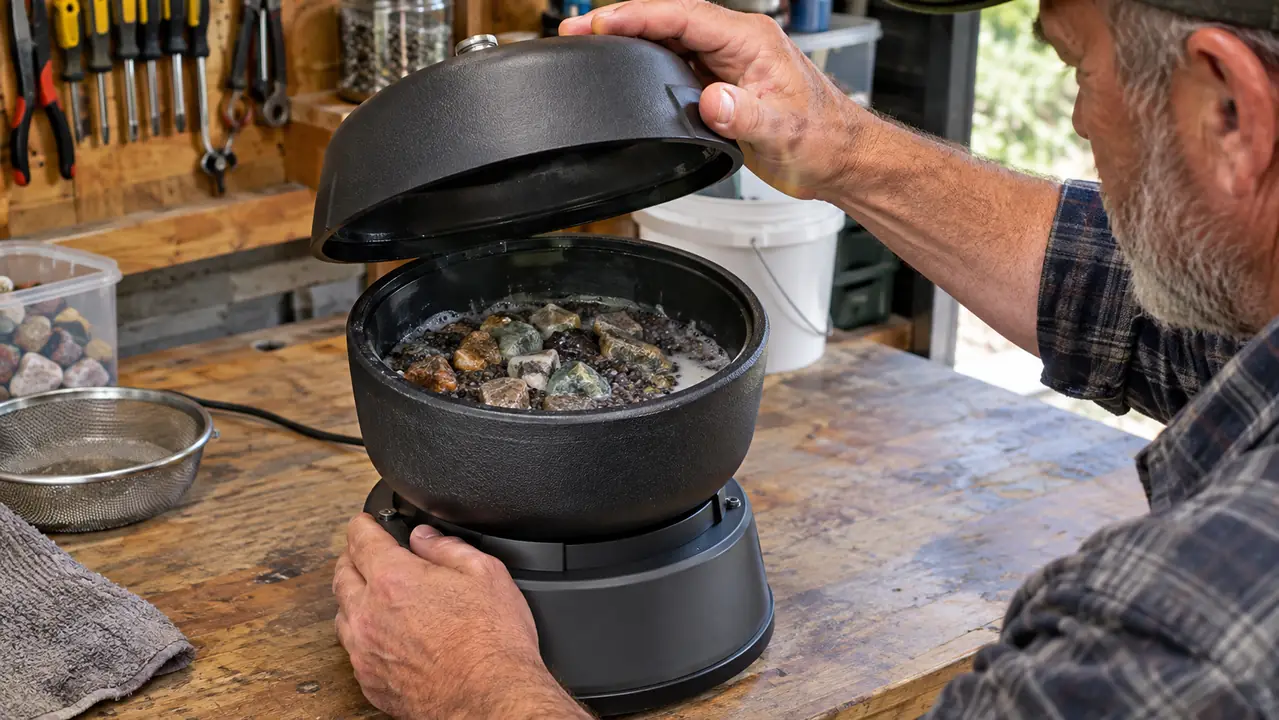
My routine changed once I understood what the machine is for. Rough shaping still happens in the rotary tumbler in the other corner, which runs for weeks at a time. When a batch comes out of the rotary at the 600 grit stage, I move it to the TV-5 for the final steps. A vibratory tumbler shakes the bowl so the stone and the media slide against each other, and because nothing drops, the stone keeps its shape while the surface gets worked. That is the whole trick, and it took me a couple of ruined batches to appreciate it.
I keep a log on a clipboard above the bench, a habit from my machinist days. Date, stage, media, grit, hours. After about eight months the log started looking boring, which is exactly what I want from a machine. The TV-5 has run steady, the plastic bowl has held up, and the only part I have replaced is a rubber bushing, which I wore out by overloading the bowl with wet sand one afternoon. That was my fault, not the machine's.
Why a Vibratory Tumbler Earns Its Spot on the Bench
The short version is that a rotary tumbler shapes and a vibratory tumbler finishes. If you put rough stone straight into a vibratory bowl, you will be disappointed. The vibration does not have the energy to knock the edges off a jagged rock the way a tumbling barrel does. But once the stone is already shaped, the vibratory bowl does in a day or two what a rotary barrel does in three weeks, and it does it with less bruising on the stone.
There is a full comparison of the Raytech TV-5 versus a rotary rock tumbler elsewhere on this site, but the practical difference comes down to motion. In a rotary barrel the stone falls through itself, which rounds off corners and can bruise the surface. In the vibratory bowl the stone stays in place while the media and the slurry work the surface. That is why the shine starts to show up in hours instead of weeks.
The tradeoff is that the vibratory machine is a specialist. It will not do the whole job alone, and I treat mine as the second half of a two machine system. That is the honest way to think about it. If you only want one tumbler and you are starting from rough rock, buy the rotary first and add a vibratory later.
What a Year of Batches Taught Me
The biggest lesson is that the TV-5 rewards attention. You cannot set it and forget it the way you can a rotary barrel. The slurry needs checking, the water level needs topping up, and if you walk away for a weekend you can come back to a bowl of mud and stone that has stopped moving. I ruined a batch of good agates that way early on, by letting the bowl run dry. The machine kept vibrating, but the slurry turned to paste and the stones just sat there. That was a Tuesday in May. I had loaded the bowl in the morning, gone inside for lunch, and not come back until supper. The paste had dried into a crust on the stones, and it took me two hours at the sink with a stiff brush to clean the bowl and the media. The agates survived after a day back in clean grit, but I have not skipped a water check since.
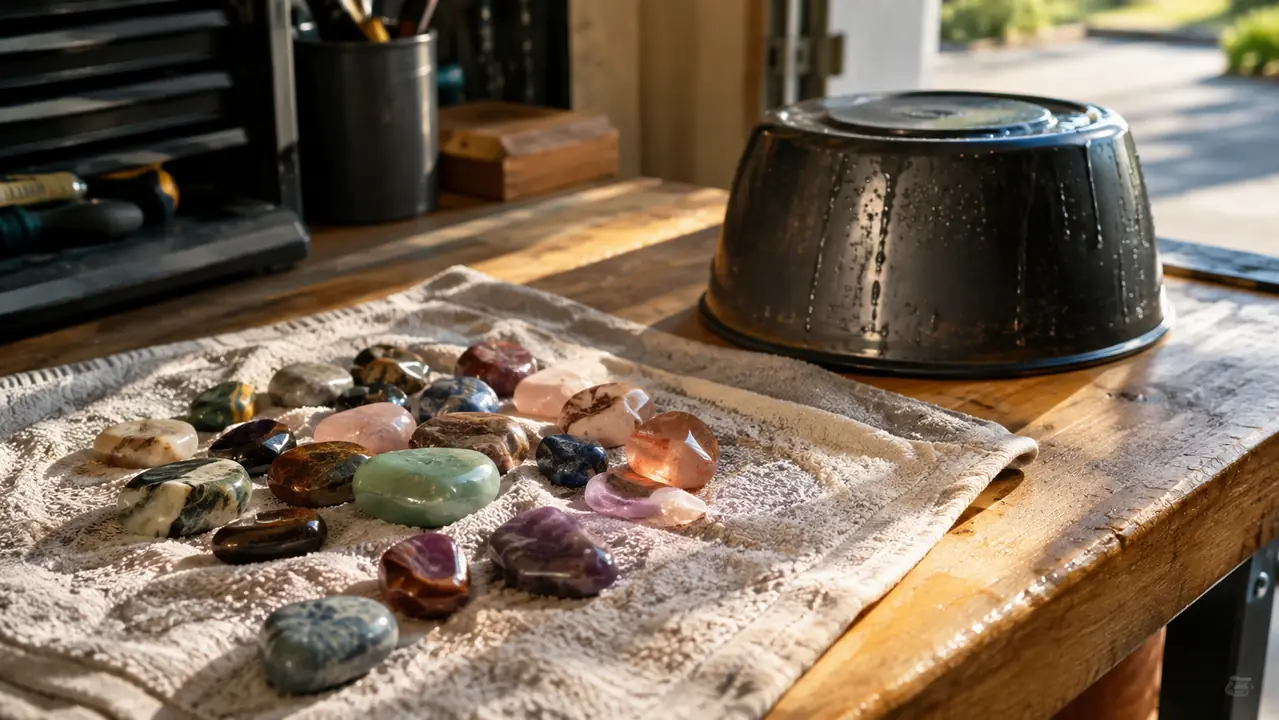
Once I learned the rhythm, the results got consistent. My standard finish cycle is a day in 600 grit, a day in 1200 grit aluminum oxide, then a burnish with plastic pellets and a squirt of dish soap. That routine turns out a shine I used to get only after a full three week rotary cycle. The stone comes out clean, the color looks deeper, and I do not have to wait a month to see it.
The other thing the log showed me is that the machine is dependable. I have run it for roughly two hundred hours over the year. The motor starts every time, the bowl does not leak, and the plastic has not cracked in the Tucson heat, which is more than I can say for some cheap equipment I have owned. The only real maintenance is rinsing the bowl and checking the bushing every couple of months.
Media and Polish: What Actually Works
Vibratory tumbling runs on media, the little pellets that carry the grit against the stone. I use plastic pellets for the polish stage and a mix of ceramic cones for the earlier grit stages. The TV-5 does not care what you feed it, but the ratio matters. I run about half media to half stone by volume, with just enough water to make a slurry. Too little water and the bowl stalls. Too much and you are just splashing.
On the polish stage, the trick is patience with a short clock. I check the bowl every few hours, because vibratory polish can be done in a day or overdone in two. Overpolishing makes the stone look waxy, a mistake I made twice before I learned to stop at the first good shine. There is an article on this site about the reasons a vibratory tumbler polishes faster, but the short answer is contact. The stone stays in constant contact with the media, so the work happens continuously instead of once per revolution.
One more note on media: keep it clean. When I skip the rinse between grit stages, the old grit gets carried into the polish and scratches the stone. The batch that taught me this was a set of petrified wood from a wash north of Tucson. I was in a hurry and skipped the rinse, and the polish came out dull with fine scratches you could only see in the sun. I re-ran the stones for a day with fresh pellets and clean water, and they came out right. Now the rinse is part of the routine, no exceptions. I keep a second set of plastic pellets just for the final polish, and I rinse them in a colander under the utility sink after every batch. It adds ten minutes to the routine and saves me from re-polishing half the batch.
A batch that used to take three weeks in the rotary now comes off the TV-5 in two days, with a shine I could not get in the barrel at all.
Noise, Dust, and the Realities of Shop Life
The TV-5 is not silent, and I want to be clear about that because some reviews make it sound like a whisper. It hums, and the hum carries through the garage wall. It is quieter than a rotary tumbler, which thumps and rattles, but it is not quiet. On the rubber mat with the garage door closed, Carol can hear it from the kitchen. Biscuit tolerates it now, but he still leaves the garage when the bowl is running full of ceramic media.
Dust is the other reality. The slurry dries on the rim of the bowl and on the workbench, and the fine grit powder gets everywhere if you are careless. I keep a spray bottle of water at the sink and rinse the bowl outside after every batch. The utility sink in my garage was a good investment for this hobby, and I would not run any tumbler without one nearby.
Placement matters more than I expected. The machine walks slightly on the bench, so I keep it on a level surface with the rubber mat underneath. In twelve months it has not walked off the bench, but it has shifted a couple of inches on a long run. That is worth knowing before you set it next to something fragile. One night I set it too close to a tray of finished cabs and found the tray nudged a quarter of the way across the bench by morning. Nothing broke, but the tray was resting crooked against the wall. Now I give the TV-5 a clear six inches on every side and nudge it back when I top up the water.
Alternatives I Considered
Before I settled on the Raytech, I looked hard at the other vibratory tumblers on the market. The bigger units polish faster in bigger batches, but they take up more bench space and the motor noise scales up with the size. The budget import models I saw at the Tucson gem show looked tempting at first, but the plastic bowls felt thin and the motors were the same design across three different brand names. I have fixed enough machinery in my life to know when a motor is built to be replaced.
I also considered running a second rotary tumbler instead, since I already had one. That would have doubled my throughput, but it would not have fixed the actual problem, which was the time each batch spent in the polish stage. The vibratory machine solved that specific bottleneck. Twelve months later, I am still glad I bought the TV-5 rather than another barrel.
What I Liked
- Finishes a polish stage in one to two days instead of two to three weeks
- Quieter than a rotary tumbler, with a steady hum instead of thumping
- Plastic bowl rinses clean and has held up through a year of regular use
- Simple, dependable motor that starts every time after roughly two hundred hours
- Stones keep their shape while the surface gets worked
Where It Falls Short
- Will not shape rough stone, it only finishes rock that a rotary already shaped
- Needs daily attention, the slurry and water levels are not set-and-forget
- Hums loud enough to hear through the garage wall
- Small bowl, so batches have to stay around two to three pounds
- Wet grit slurry makes a mess if you do not rinse the bowl right away
Who This Is For
Buy the Raytech TV-5 if you already own a rotary tumbler and you are tired of the polish stage eating your calendar. It is for the person with a shelf of half-finished stone who has already worked out grit stages and wants the finish to stop being the bottleneck. It is also for anyone who likes watching a batch come to life over a weekend instead of a month. If you are willing to check the bowl a couple of times a day and rinse it after every run, this machine will reward you.
Who Should Skip It
Skip the TV-5 if you are just starting out and do not own a rotary tumbler yet. A vibratory machine will frustrate you if you feed it rough rock, because it will not do the shaping work. Skip it if you want a machine you can ignore for three weeks at a time, because the TV-5 asks for daily attention. And skip it if you need to run big batches, because the bowl is sized for hobby batches, not for processing buckets of stone. None of those are flaws in the machine. They are just reasons to buy it at the right point in your own setup.
The Finishing Tool That Earned Its Spot on My Bench
After a year of steady use, the Raytech TV-5 is the first machine I reach for when a batch hits the polish stage. If that sounds like the gap in your own shop, check today's price on Amazon and see if the TV-5 belongs on your bench too.
Amazon Check Today's Price on Amazon →